European Union Law on Organic Production
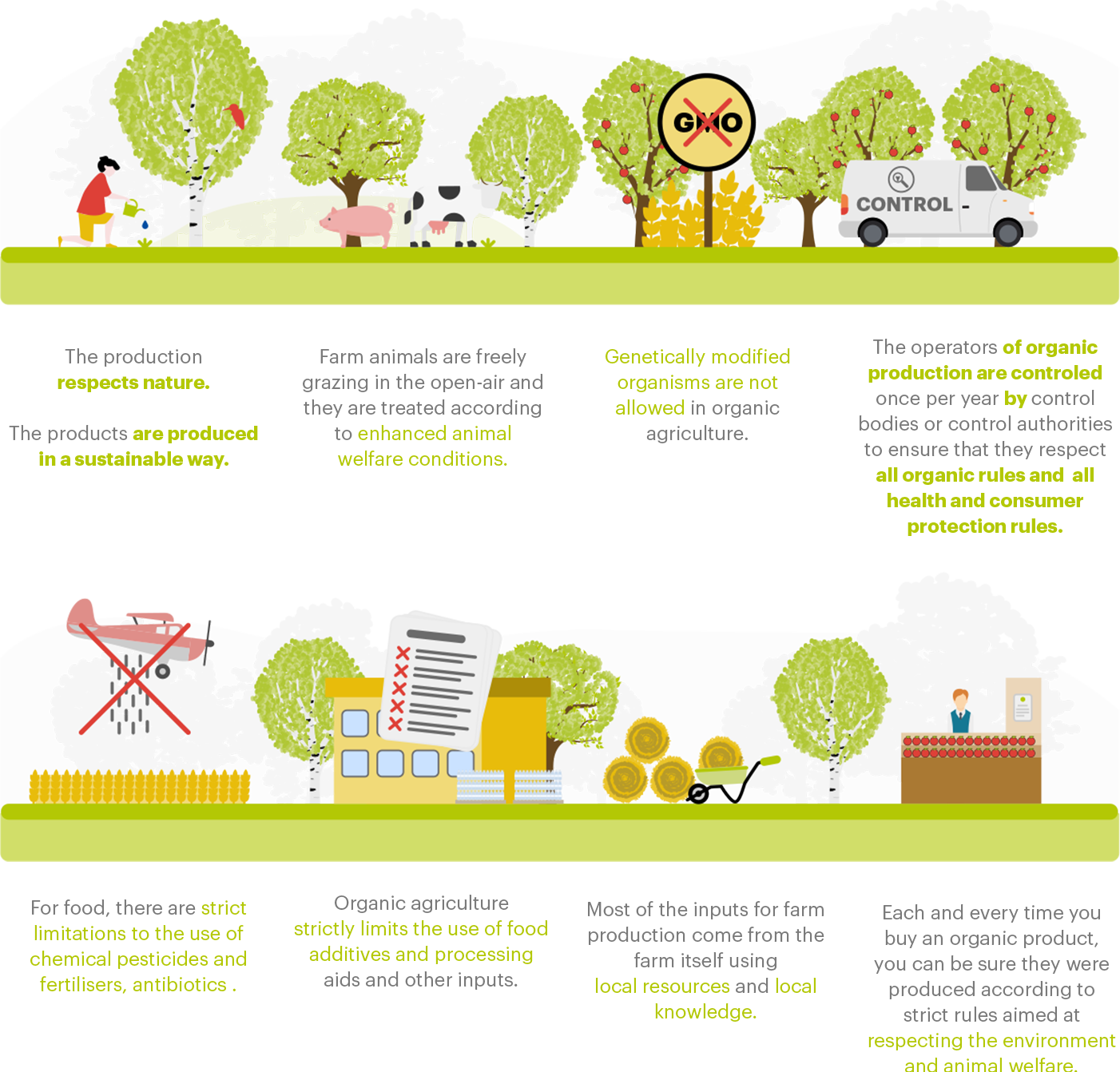
The legal requirements set out in the EU Regulation offer a guarantee that organic products respect all the rules.
In 2007 the European Council of Agricultural Ministers agreed on a new Council Regulation (Council Regulation (EC)
No. 834/2007) setting out the principles, aims and overarching rules of organic production and defining how organic
products were to be labelled.
The regulation set a new course for developing organic farming further, with the following aims:
Labelling organic foods
Foods may be labelled "organic" only if at least 95% of their agricultural ingredients meet the necessary standards.
In non-organic foods, any ingredients which meet organic standards can be listed as organic. To ensure credibility,
the code number of the certifying organisation must be provided.
Food Quality Policy
The Regulation (EU) No 1151/2012 on quality schemes for agricultural products and foodstuffs entered into force in
the beginning of 2013. It creates a more robust framework for the protection and promotion of quality agricultural
products and thus contributes to guaranteeing quality to consumers and a fair price for farmers.
The control bodies are entitled to run control on each organic operator and investigate whether the production is according to the standards. Organic operators are controlled once a year to make sure that the rules are respected and if they are, the products may bear the organic logo of the European Union. There are two years of conversion period in organic farming before a product can be marketed as organic.
The key elements of Regulation include: